Agentic Logistics: The Self-Booking Container
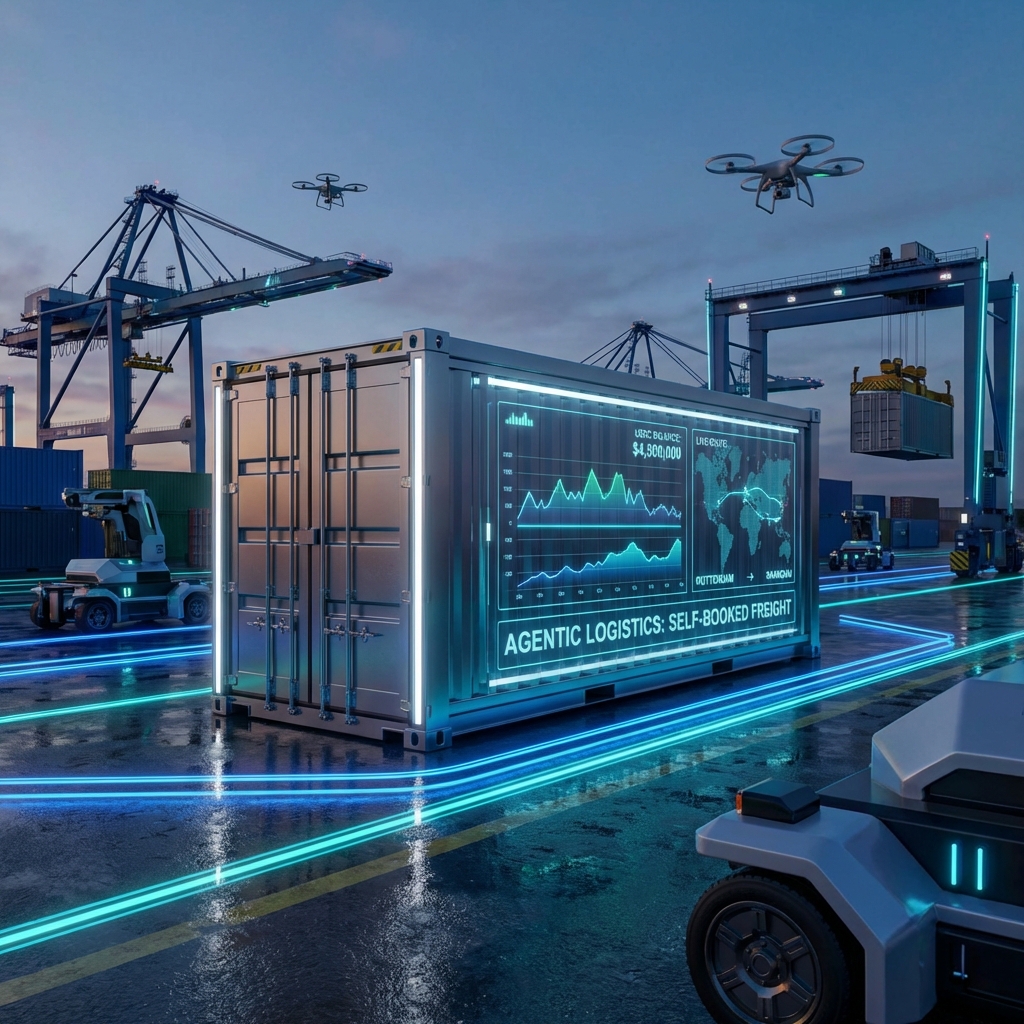
Assets are no longer passive cargo; they are economic actors. How AI agents embedded in shipping containers are negotiating their own freight.
Agentic Logistics marks the transition from centralized orchestration to distributed autonomy. Shipping containers, pallets, and parcels now possess their own wallets and agentic models, allowing them to bid for slot space, negotiate insurance, and clear customs without human intervention.
For fifty years, logistics has been a 'push' system. Humans decide where cargo goes, and systems track it. In 2026, we have inverted the model. Cargo now 'pulls' itself through the supply chain. This is more than an efficiency upgrade. It changes how routing is architected that eliminates the 'Bullwhip Effect' by allowing supply to react to demand in real-time.
The Technical Protocol: How Negotiation Works
Agentic Logistics depends on the negotiation handshake. Unlike EDI (Electronic Data Interchange), which simply transmits static documents, the Sovereign Interoperability Protocol enables dynamic, bilateral negotiation between the Cargo Agent and the Carrier Agent.
The process is completely autonomous, governed by smart contracts on the DePIN Infrastructure . Here is the sequence of events that occurs when a container needs to book a slot:
Visualising the Handshake
This entire sequence executes in under 400 milliseconds. There are no emails, no brokers, and no waiting for confirmation. The 'Tokenised Bill of Lading' is instantly deposited into the Container's wallet, acting as both proof of ownership and a ticket for entry.
Real-World Use Case: The 'Reefer' Meltdown
To understand the value of this system, consider a failure scenario. A refrigerated container ('Reefer') full of Wagyu beef is stuck at a port in Singapore. The compressor fails, and the internal temperature begins to rise.
In the legacy model, the sensor might send an alert, but a human operator in London (asleep) misses it. The cargo spoils, resulting in a $500,000 insurance claim.
In the Agentic model, the Container Agent detects the temperature variance. It immediately queries the local port mesh for 'Emergency Cold Storage'. It identifies a facility 2km away, negotiates a premium rate for immediate access, and hires an autonomous drayage truck to move it there. The cargo saves itself.
Conclusion: The Self-Driving Supply Chain
We are moving from a world where we manage assets to a world where assets manage themselves. This shift reduces waste, optimizes capacity, and creates a supply chain that is truly antifragile.
Digital Product Passports for the Automotive Supply Chain
Digital Product Passport automotive supply chain: EV battery passports, OEM traceability, and EU Battery Regulation reporting. Start with a free readiness scan.