The Origin of the Internet of Things
Professor Duncan McFarlane shares his version of the Origin of the Internet of Things (IoT) and the founding of the Auto-ID Centre.
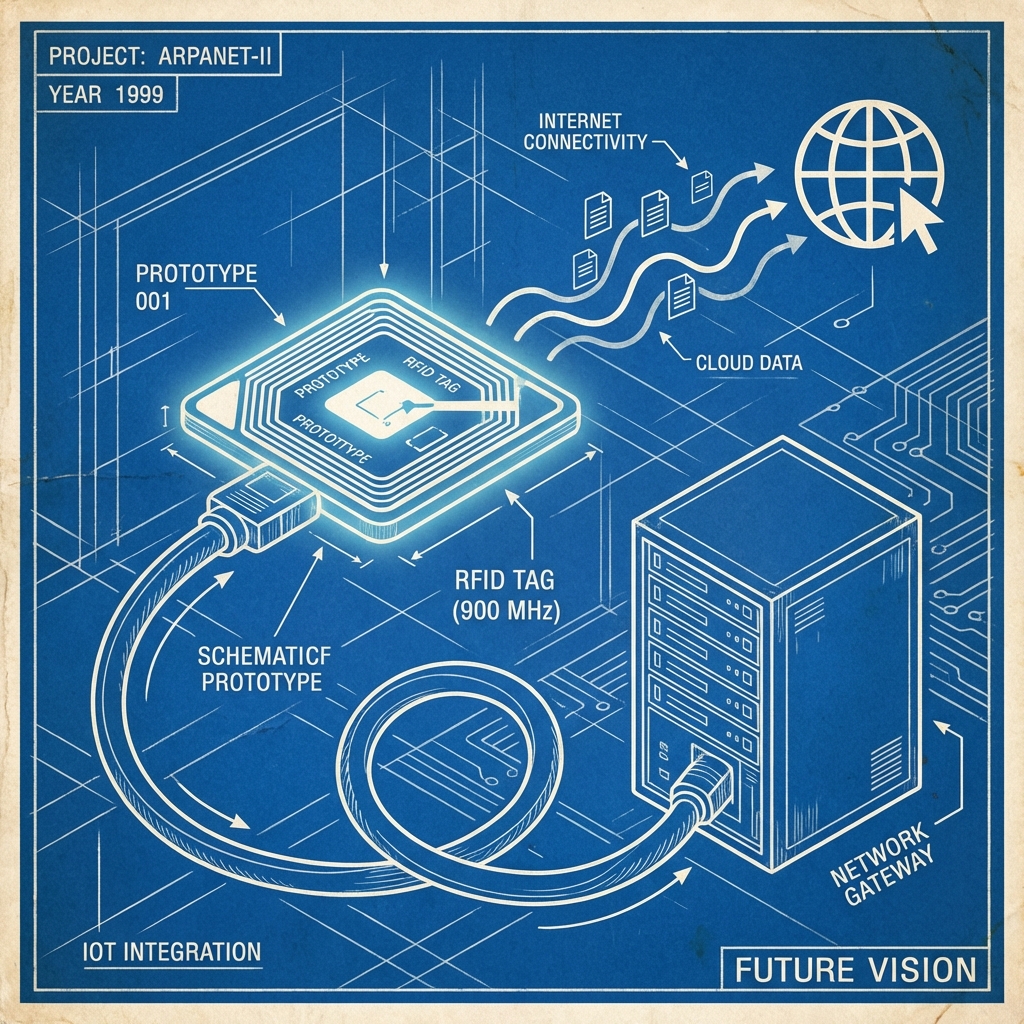
The term 'Internet of Things' originated from the Auto-ID Centre in 1999, founded by Kevin Ashton, Sanjay Sarma, and David Brock. Their goal was to connect physical objects to the internet via RFID, enabling a world where every item could be uniquely identified and tracked.
Most of you have probably heard the Internet of Things, or the IoT, mentioned but have you ever wondered what it means and where it all began? This is the story of how a supply chain problem at P&G led to the Auto-ID Centre and the IoT label.
1999: The Lipstick Problem
In 1999, Kevin Ashton was a brand manager at P&G. He had a problem: a specific shade of lipstick kept selling out, but the inventory systems said it was in stock. The data in the computer did not match the reality on the shelf. This gap between the digital and the physical, was the catalyst.
Ashton realized that computers were dependent on humans to give them data. But humans are busy, error-prone, and bored. He hypothesized that if computers could gather data for themselves, using sensors like RFID, they would be able to track the world with a precision humans could never match.
Timeline: The Evolution of a Concept
Why the Vision Stalled (2008-2020)
The original vision of the Auto-ID Centre was highly decentralized: 'Information about the object stays with the object'. However, the Web 2.0 era (2008-2020) forced a pivot to centralization. We started pumping petabytes of sensor data into central clouds (AWS, Azure) to be mined.
This broke the original promise. It created 'Data Silos'. A sensor in a shipping container sent data to Maersk's cloud, which didn't talk to the Port's cloud, which didn't talk to the Trucker's cloud. We built an Intranet of Things, not an Internet of Things.
2026: Returning to the Source
In 2026, we are finally returning to the original vision, but with new tools. DePIN and Agentic AI allow us to build the decentralized fabric that Ashton and Sarma dreamed of.
"We are finally building the Internet of Things, not just the Cloud of Things.
Objects now have their own wallets. They pay for their own connectivity. They own their own data. The lipstick on the shelf doesn't just tell the server it's there; it negotiates its own replenishment order.
Explore how this original vision has evolved into the Machine Economy of 2026, where assets not only have identity but economic sovereignty.
RFID Tracking & Intelligence
Enterprise RFID asset tracking solutions: fixed portals, handheld bulk scans, cloud middleware, and WMS/ERP integration for 99%+ inventory accuracy.