State of the Machine Economy 2026
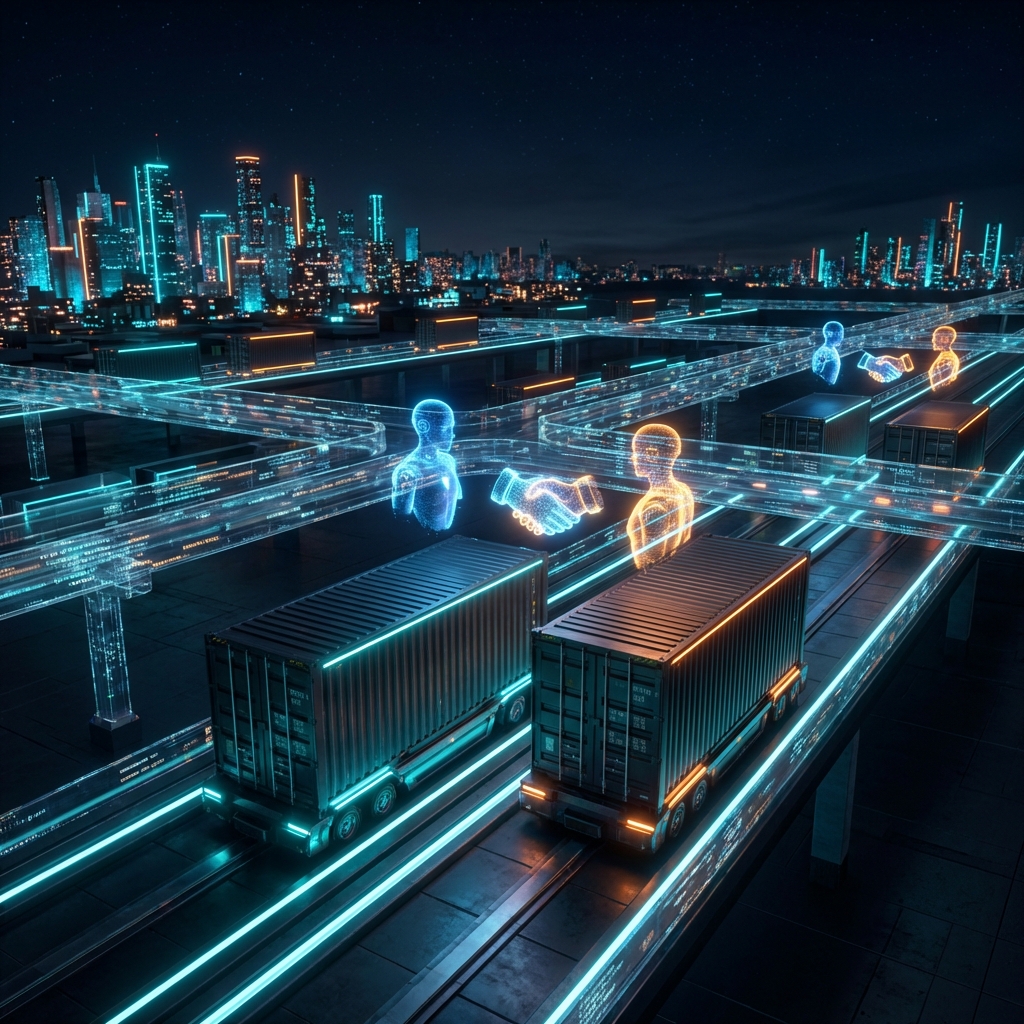
In 2026, machine-to-machine transactions in industry are overtaking human-mediated ones. We look at three trends driving that shift.
The State of the Machine Economy in 2026 is defined by 'Sovereign Interoperability'. With the adoption of AI Agents in supply chains reaching critical mass, we are seeing the first true 'lights-out' logistics networks where assets negotiate their own passage without human intervention, unlocking $3.2T in global efficiencies.
As of January 2026, machine-to-machine (M2M) economic transactions in industry have passed human digital transactions for the first time we can measure reliably. The Machine Economy is now how a large share of industrial trade runs. The shift built on three technologies maturing together: Sovereign Identity (SSI), Agentic AI, and DePIN.
The Three Pillars of the 2026 Machine Economy
What we are seeing rests on three pillars. Drop any one of them and the system falls back to a traditional, siloed database model.
1. Agentic Logistics (The "Pull" Model)
The first pillar, Agentic Logistics , has been the most visible transformation. We are now seeing shipping containers that not only track their location but actively bid for slot space on container ships using their own wallets. This has smoothed out volatility in spot rates and increased utilization by 22% industry-wide. In this model, the cargo 'pulls' itself through the supply chain, rather than being 'pushed' by central dispatchers.
2. Tokenised Provenance (The Digital Title)
Mere tracking is insufficient for autonomy; assets need legal standing. Through RWA Tokenisation , the physical possession of a good is legally bound to a digital token. When an agent transfers a token, it transfers the legal title. This allows for 'Flash Trade Finance', where goods are collateralized and financed in the milliseconds between leaving a warehouse and entering a truck.
3. The Death of the ERP (Live State Machines)
Legacy ERPs fail because they are passive snapshots of the past. In 2026, supply chains require active, state-aware actors. A static database cannot compete with an agentic mesh that reacts to weather disruptions, tariff, and demand spikes in milliseconds rather than days.
Visualising the Agentic Mesh
The architecture of 2026 is no longer a 'Hub and Spoke' model controlled by a central cloud. It is a distributed Mesh where every node (factory, truck, pallet) is a peer.
In the diagram above, note that there is no central dispatcher. The Factory Agent broadcasts a need, and autonomous Truck Agents bid for the work. The 'DePIN Oracle' acts as the neutral referee, cryptographically proving that the truck actually arrived before payment is released. This entire cycle happens without human review.
Data Comparison: Legacy ERP vs. Agentic Mesh
The efficiency gains are not marginal; they are structural. By removing the 'human middleware' from the verification loop, we see order-of-magnitude improvements in speed and settlement.
| Metric | Legacy ERP (2020s) | Agentic Mesh (2026) |
|---|---|---|
| Decision Latency | 24-48 Hours | < 300 Milliseconds |
| Settlement Time | 30-90 Days (Net30) | Instant (Per Block) |
| Data Trust | Self-Reported (Audited) | Cryptographic (Zero-Knowledge) |
| Topology | Centralized Hub | Peer-to-Peer Mesh |
| Cost of Trust | High (Brokers/Insurers) | Low (Code/Protocol) |
"The ERP was the filing cabinet of the 20th century. The Agent is the workforce of the 21st.
The Economic Impact: $3.2 Trillion Unlocked
According to the latest RedBite Research Lab findings, the transition to sovereign interoperability unlocks $3.2 trillion in global idle capacity. Where does this value come from? It comes from 'Dead Capital', assets that are sitting idle because the transaction costs to utilize them are too high.
Consider a forklift sitting idle in a warehouse for 4 hours. In 2020, renting it out involved contracts, insurance forms, and scheduling calls. The friction cost exceeded the value of the rental. In 2026, that forklift has an AI Agent . It detects its own idle time, posts availability on the local industrial mesh, and a neighboring facility rents it for 4 hours using a micro-insurance smart contract. The friction is near zero, and the dead capital becomes productive.
What does this mean for your business?
If your digital transformation strategy is still focused on 'Dashboards' and 'Analytics', you are fighting the last war. The goal is no longer to show a human a graph so they can make a decision. The goal is to allow the machine to make the decision itself.
At RedBite, we have aligned our entire technology stack, from the itemit platform to our contributions to the umin.ai protocol to support this transition. We track assets and give them identity, wallets, and executable policy. The winners of the next decade will not be the companies with the best charts; they will be the companies with the smartest agents.
The AI Agent Economy: Autonomous Physical Operations
AI agent economy IoT asset tracking: autonomous negotiation, DePIN-ready sensors, and machine-speed logistics. Built by Cambridge Auto-ID alumni via umin.ai.