A Short History of Physical AI: From Holons to Intelligent Products
"What does a cell in your body have to do with a product on a factory floor?"
Prof Duncan McFarlane asked me that early in my PhD, and I had no idea where he was going with it.
He started sketching. A cell looks after itself: it takes in what it needs, repairs itself, reacts to what's around it. But it's also part of an organ, and the organ is part of a body. Arthur Koestler had a name for that, a holon, something that is a whole and a part at once. "Now imagine a factory built like that," he said. No master controller. Machines, orders and products each acting as agents, sorting things out between themselves and carrying on when something breaks. He'd been building exactly that since the 1990s, long before anyone called software agentic.
The field now called physical AI covers the same ground: artificial intelligence that senses and acts in the physical world, through robots, machines, vehicles and the products they handle. Its hardest questions, about autonomy, cooperation and what happens when something fails, were being worked on in factories thirty years ago.
What is a holon?
A holon is something that is a whole in its own right and, at the same time, a part of something larger. Koestler coined the word in his 1967 book The Ghost in the Machine. He described every holon as Janus-faced. Looking down the hierarchy it behaves as a self-contained whole; looking up, it behaves as a dependent part. Each one carries two tendencies, a self-assertive one that protects its autonomy and an integrative one that makes it serve the larger system, and the system stays healthy only while the two are in balance. Nothing in that account is specific to biology, which is what made it useful to engineers.
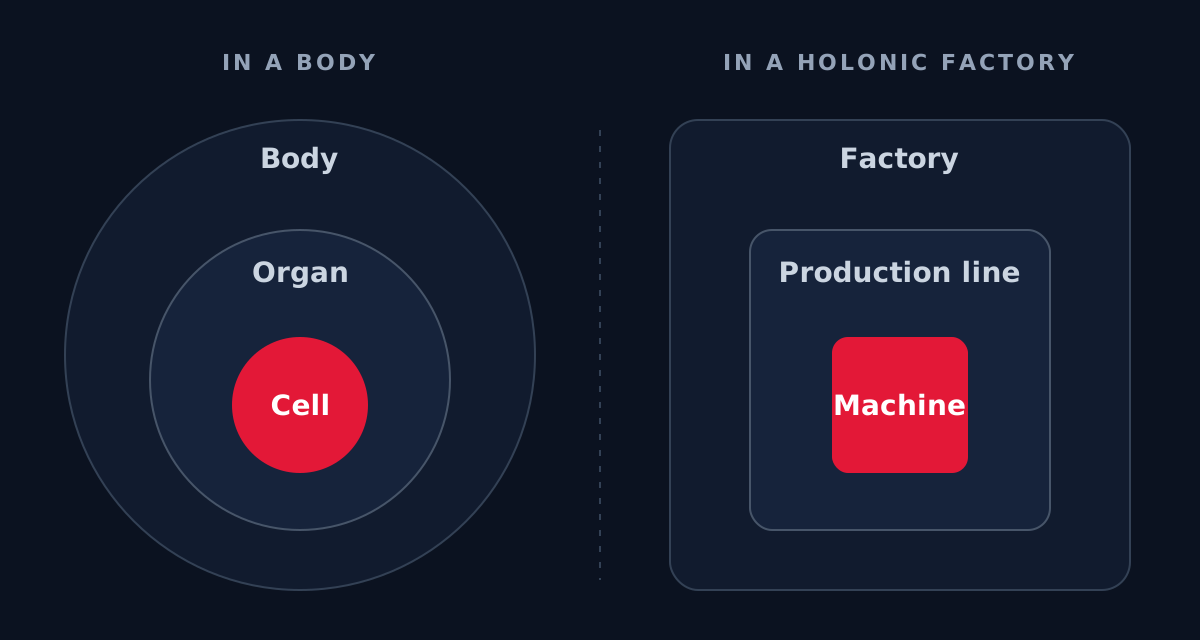
What is holonic manufacturing?
Holonic manufacturing applies the holon to factory control. In the 1990s the international Holonic Manufacturing Systems consortium, part of the Intelligent Manufacturing Systems programme, set out to make it work. Instead of a fixed hierarchy pushing schedules down from the top, control is spread across autonomous, cooperative units that plan for themselves and negotiate with one another: a multi-agent system, in today's terms. The PROSA reference architecture developed at Leuven, for instance, builds a factory from product, resource and order holons (Van Brussel et al., 1998). Duncan was among those who made the engineering case for the approach, setting out with Stefan Bussmann why holonic control suits factories that face frequent disturbance and change (McFarlane and Bussmann, 2000).
What is Auto-ID?
Auto-ID, short for automatic identification, covers the technologies that let machines recognise physical objects without a person reading a label, such as barcodes and RFID tags. Duncan saw that identity had to come before agency, because an agent has to know what it is before it can act. He brought that thinking to the Auto-ID work, which gave physical objects a digital identity and is now built into supply chains around the world.
The Auto-ID Center, founded at MIT in 1999 with Cambridge joining soon after, gave each object a unique Electronic Product Code carried on a low-cost RFID tag, and kept the information about the object on the network, not on the tag. That was the piece holonic systems had been missing: a product cannot negotiate on its own behalf if nothing on the shop floor can tell which product it is. In a 2003 paper with Sanjay Sarma, Jin Lung Chirn, Kevin Ashton and me, Duncan set out how Auto-ID systems could support exactly this kind of product-driven manufacturing control (McFarlane et al., 2003).
What is an intelligent product?
An intelligent product is a physical item with a digital identity of its own, able to communicate, to hold information about itself and to take part in decisions about what happens to it.
Identity was only the first step, though. The question Duncan kept coming back to was how to make a product truly intelligent, with agency of its own, and I had the pleasure of working on it with him. Taking our cue from holons, we arrived at a product that knows what it is, talks to the world around it, and has a say in its own fate.
Our first paper on the idea, written at the Cambridge Auto-ID Centre, used a jar of spaghetti sauce as its worked example (Wong et al., 2002). It defined an intelligent product as one with some or all of five characteristics:
- A unique identity.
- The ability to communicate with its environment.
- The ability to store data about itself.
- A language in which to express its features and production requirements.
- The ability to take part in, or make, decisions about its own destiny.
The first three make a product information-oriented, which we called Level 1 intelligence. All five make it decision-oriented, Level 2: a product that can assess and influence what happens to it rather than only report its status. That combination of identity and intelligence became the basis on which we spun out RedBite together.
The definition became a common reference point in the research on intelligent products that followed (see the survey by Meyer, Främling and Holmström, 2009). Ten years on, we tested it against what industry had actually deployed (McFarlane et al., 2013), and last year, with Duncan and colleagues at RedBite, I updated it as Intelligent Product 3.0, adding decentralised identity, blockchain-based product records and collaboration between AI agents (Wong et al., 2025).
What does this mean for physical AI?
Decades later, physical AI is running into the same questions his group was working on back then. How much autonomy should each agent have, and how do agents cooperate when nobody is in charge? What happens to the whole system when one of them fails? The tools have changed a great deal since then, but those questions haven't.
The holonic and multi-agent manufacturing literature has worked on each of them. Fully decentralised control tends to be myopic: each agent optimises its own situation while overall performance suffers, which is one reason PROSA added staff holons that advise the others without taking control away from them. The same body of work treats autonomy as something to bound and design, not simply grant, and treats a system's response to a failed component as something to engineer and test before relying on it. None of that changes in the era of agentic AI, when the agents are AI models directing robots instead of scheduling rules directing machine tools.
Identity matters as much now as it did then. An AI agent that reroutes a shipment or schedules maintenance is only as reliable as its knowledge of which physical thing it is acting on and what state that thing is in. The European Union's Digital Product Passport is a regulatory version of the same idea: a persistent, machine-readable identity for each product, carried through its life.
Duncan was elected a Fellow of the Royal Academy of Engineering this month, and I have written a short note of congratulation to mark it.
References
- Koestler, A. (1967) The Ghost in the Machine. London: Hutchinson.
- Van Brussel, H., Wyns, J., Valckenaers, P., Bongaerts, L. and Peeters, P. (1998) Reference architecture for holonic manufacturing systems: PROSA. Computers in Industry, 37(3), 255-274.
- McFarlane, D.C. and Bussmann, S. (2000) Developments in holonic production planning and control. Production Planning & Control, 11(6), 522-536.
- Wong, C.Y., McFarlane, D., Ahmad Zaharudin, A. and Agarwal, V. (2002) The intelligent product driven supply chain. IEEE International Conference on Systems, Man and Cybernetics.
- McFarlane, D., Sarma, S., Chirn, J.L., Wong, C.Y. and Ashton, K. (2003) Auto ID systems and intelligent manufacturing control. Engineering Applications of Artificial Intelligence, 16(4), 365-376.
- Meyer, G.G., Främling, K. and Holmström, J. (2009) Intelligent Products: A survey. Computers in Industry, 60(3), 137-148.
- McFarlane, D., Giannikas, V., Wong, A.C.Y. and Harrison, M. (2013) Product intelligence in industrial control: Theory and practice. Annual Reviews in Control, 37(1), 69-88.
- Wong, A.C.Y., McFarlane, D., Ellarby, C., Lee, M. and Kuok, M. (2025) Intelligent Product 3.0: Decentralised AI Agents and Web3 Intelligence Standards. arXiv:2505.07835.
The AI Agent Economy: Autonomous Physical Operations
AI agent economy IoT asset tracking: autonomous negotiation, DePIN-ready sensors, and machine-speed logistics. Built by Cambridge Auto-ID alumni via umin.ai.