Intelligent Product 3.0: Decentralised AI Agent Blueprint
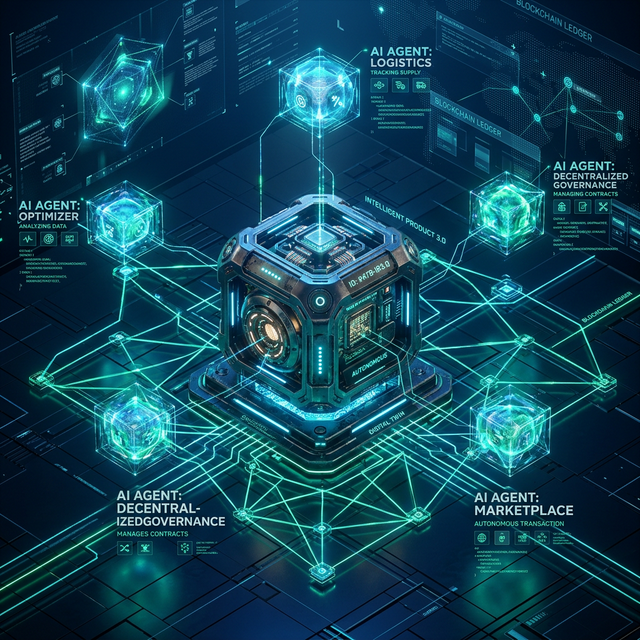
RedBite and Cambridge University unveil Intelligent Product 3.0: bridging physical assets with decentralised AI agents and Web3 ledgers.
Intelligent Product 3.0 represents a fundamental shift from passive, centrally-tracked assets to autonomous, economically active entities. By integrating Decentralised Physical Infrastructure Networks (DePIN), Agentic AI, and blockchain validation, physical objects can now negotiate, transact, and collaborate with other machines without human intervention.
Twenty-five years ago, researchers at the Auto-ID Center at Cambridge and MIT envisioned an ambitious future: everyday objects possessing unique identities, capable of communicating their status and influencing their own destiny. This laid the foundation for the Electronic Product Code (EPC) and the Internet of Things (IoT).
Yet, for two decades, these 'intelligent' systems were predominantly Level 1 (Information-Oriented). They could tell a centralised server where they were, but they lacked the true autonomy required for Level 2 (Decision-Oriented) intelligence. They were constrained by rigid, rule-based APIs and siloed corporate databases.
Today, we are announcing a new research specification published on arXiv: Intelligent Product 3.0: Decentralised AI Agents and Web3 Intelligence Standards. Co-authored by researchers from the Cambridge University Auto-ID Lab and RedBite Solutions, this paper outlines how recent breakthroughs in Web3 and generative AI finally bring the original vision to life.
What are the core pillars of Intelligent Product 3.0?
- Decentralised Physical Infrastructure Networks (DePIN): Utilising community-driven IoT backbones to reduce dependency on centralised cloud providers and eliminate single points of failure.
- Agentic AI & LLMs: Embedding intelligence directly at the edge, allowing products to autonomously assess unstructured data, negotiate interactions, and execute logic without predefined rules.
- Web3 Intelligence Standards: Using Decentralised Identifiers (DIDs) and Distributed Ledgers so products can authenticate themselves, prove their status, and transact securely across any ecosystem.
Migrating from Legacy IoT to Decentralised AI
For enterprise leaders, the leap to Intelligent Product 3.0 is not merely an academic exercise; it represents the necessary evolution away from fractured, legacy IoT deployments. Historically, deploying 'smart' sensors required vendor lock-in with monolithic cloud architectures. These centralised models created vast data silos, making cross-supply-chain consensus nearly impossible and continuously driving up cloud compute expenses as data volumes scaled.
Intelligent Product 3.0 resolves these commercial friction points. By moving from 'cloud-first' to 'edge-first', and replacing proprietary APIs with unified Web3 semantic layers, enterprises can dramatically lower their integration costs. Products are no longer tethered to a single manufacturer's server; they arrive with built-in, cryptographically secure wallets and AI decision engines, ready to integrate into any supply chain instantly. This is the infrastructure layer described in depth in our DePIN: The Nervous System of the Physical World report.
How does Intelligent Product 3.0 differ from traditional IoT?
Traditional IoT relies on centralised cloud computing to dictate actions. Intelligent Product 3.0 utilises Decentralised Identifiers (DIDs) and Edge AI to enable hybrid 'on-board' intelligence. Products no longer just stream telemetry; they parse unstructured data, verify their own Digital Product Passports on a blockchain, and execute smart contracts autonomously.
| Feature | Intelligent Product 1.0/2.0 (Legacy IoT) | Intelligent Product 3.0 |
|---|---|---|
| Identity | Centralised EPC / Barcode | Decentralised Identifier (DID) |
| Communication | Structured, Predefined API | Agentic AI with Adaptive NLP |
| Data Storage | Siloed Cloud Databases | Blockchain & DPP ledgers |
| Decision Making | Rule-based, Human-dependent | Autonomous LLMs & Multi-Agent Systems |
The bottleneck of legacy IoT is interoperability. If an asset managed by Company A moves into the warehouse of Company B, the systems rarely talk to each other intuitively. Intelligent Product 3.0 upends this by abandoning rigid, proprietary APIs in favor of a shared, trustless machine economy interface protocol.
How do Intelligent Products negotiate in global logistics?
In global supply chains, shipping containers acting as Intelligent Products can independently negotiate freight rates, select optimal transit routes based on real-time weather data, and autonomously complete customs payments via crypto smart contracts, entirely bypassing human freight brokers.
Imagine a high-value pharmaceutical shipment travelling from Switzerland to Singapore. Under Intelligent Product 3.0, the refrigerated container (reefer) itself is an autonomous agent. Instead of a human logistics broker booking passage on a cargo ship, the container broadcasts its requirements (temperature constraints, delivery deadlines) to a decentralised freight market.
Vessels governed by their own AI agents respond with bids. The container's internal LLM evaluates the bids, factors in predictive weather delays from DePIN sensor networks, and selects the optimal vessel. It then executes a smart contract to lock in the rate and releases a micropayment autonomously upon successful loading. This machine-to-machine (M2M) negotiation is at the heart of what our State of the Machine Economy 2026 report identifies as the defining commercial shift of the decade.
How do Collaborative Embodied AIs optimise operations?
Intelligent household devices autonomously communicate and coordinate tasks with robots from different manufacturers (e.g., Tesla, Dyson, Samsung) using decentralised AI protocols. By negotiating chores across competing ecosystems, embodied AIs optimise resource usage and eliminate the need for human orchestration.
The concept translates powerfully into cross-platform interoperability. Historically, domestic robots and appliances have been rigidly isolated within their own manufacturer’s ecosystem. A vacuum cleaner from Dyson could not autonomously request physical assistance from a humanoid robotic arm made by Tesla.
Under Intelligent Product 3.0, everyday items become Collaborative Embodied AIs. Imagine a scenario where a heavy object needs to be moved to clean the floor beneath it. An intelligent vacuum autonomously communicates its objective to a general-purpose humanoid robot on the same network. They coordinate precisely using decentralised AI protocols: the robot lifts the object, the vacuum cleans the area, and the robot places it back. Using tokenised micro-transactions and unified Web3 standards, they divide the labour dynamically, drastically optimising household chores.
How do smart home appliances become economically active agents?
Home appliances will soon autonomously predict failures, hire repair technicians, and authenticate replacement parts. By directly interacting with decentralised service markets, a broken washing machine can arrange its own fix without the homeowner ever making a phone call.
The concept translates surprisingly well to everyday consumer goods and the 'smart home'. Consider the lifecycle of a washing machine. In today's setup, when a motor begins to fail, the machine might flash an error code or send an alert to a smartphone app, pushing the burden of resolution onto the consumer.
Under Intelligent Product 3.0, the appliance handles the crisis itself. Its internal edge AI detects the acoustic anomaly of a failing bearing. It queries a decentralised marketplace for local, certified repair technicians or robotic service agents. It cross-references prices and availability, schedules the repair window according to household permissions, and even autonomously orders the exact certified OEM replacement part using a secure escrow contract.
When the technician arrives, the machine interacts with them via an open machine protocol, granting access to its diagnostic logs. Once the repair is complete, the machine verifies the cryptographic identity of the new part and releases the payment.
How can Autonomous Validation secure high-value goods?
Everyday items and premium products (e.g., wine, luxury fashion) can verify their own provenance through immutable records on a decentralised ledger. This autonomous validation thwarts counterfeits without requiring central oversight or expensive third-party authenticators.
The global luxury and high-value goods market loses billions annually to sophisticated counterfeits. Legacy brand protection relies on holograms or centralised databases, both of which can be spoofed or hacked. Under Intelligent Product 3.0, physical items defend themselves.
Consider a vintage bottle of wine. Equipped with a tamper-evident NFC tag and bound to a Digital Product Passport (DPP), the bottle acts as a sovereign node. At every stage, from the French vineyard to the distributor to the final restaurant cellar, the bottle autonomously signs a transaction on a blockchain. When a consumer taps the bottle with their smartphone, they are not pinging a corporate server; they are querying a trustless, zero-knowledge proof directly from the item. If the seal is compromised, the item autonomously flags its own DPP as invalid, instantly freezing its market value. For a deeper look at how this model applies to fine wine specifically, see our article on tokenising fine wine as a Real World Asset.
How does Intelligent Product 3.0 drive the circular economy?
By utilizing mandatory Digital Product Passports (DPP), Intelligent Products can self-certify their environmental impact, autonomously coordinate their own recycling at end-of-life, and calculate their residual material value on decentralised secondary markets.
The European Union's upcoming Digital Product Passport mandate requires items to trace their entire material history. Intelligent Product 3.0 makes this scalable. When an electronic device nears its end-of-life, it doesn't just get thrown in a bin. It actively participates in its own recycling.
The device broadcasts its exact bill of materials, rare earth metals, plastics, circuits to a network of recycling agents. It calculates its own residual scrap value, negotiates a pickup from a reverse-logistics courier, and ensures that its materials are sustainably reclaimed. The entire process is recorded immutably on its Digital Product Passport, proving compliance to regulators without a single human auditor.
How do we ensure safety and human control over autonomous products?
As physical products gain agency, mandatory 'fail-safe' cryptography and Explainability Frameworks prevent rogue behaviour. Every autonomous decision is mathematically anchored to a distributed ledger, ensuring total transparency, while dynamic 'kill switches' allow humans to immediately revoke a product's agency.
The transition from passive sensors to active, embodied AI introduces significant ethical and safety concerns. A hallmark of Intelligent Product 3.0 is the integration of algorithmic transparency directly into the physical object's governance layer. If an AI agent controlling a logistics fleet begins hallucinating or exhibiting misaligned behaviour, the smart contract immediately pauses execution pending human arbitration.
At RedBite, we implement these standards in production and help define what comes next. The work we started 25 years ago in the Cambridge Auto-ID lab is now running at scale. We are moving from the Internet of Things to an autonomous Economy of Things.
The AI Agent Economy: Autonomous Physical Operations
AI agent economy IoT asset tracking: autonomous negotiation, DePIN-ready sensors, and machine-speed logistics. Built by Cambridge Auto-ID alumni via umin.ai.